Monday, 24 March 2014

Laura Oldfield Ford


Another contemporary artist who combines the theoretical, the literary and the visual is Laura Oldfield Ford, whose work focuses on an exploration of the politics of development and the urban landscape, in the "psychoegeographic" tradition of the artists of the Situationist International.

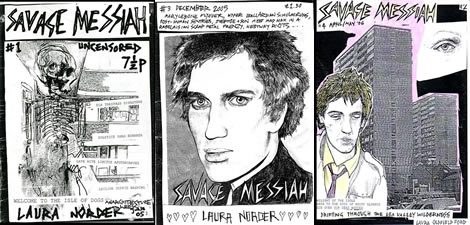
Part of her practice has been the production of a zine (which ran from 2005-9) and then a blog, entitled Savage Messiah.

Here's her blog:
http://lauraoldfieldford.blogspot.co.uk/

A book version of Savage Messiah was published by Verso in 2011 - see Verso's website here:
http://www.versobooks.com/books/1022-savage-messiah

From the New Statesman's review of this, by Sukhdev Sandhu:
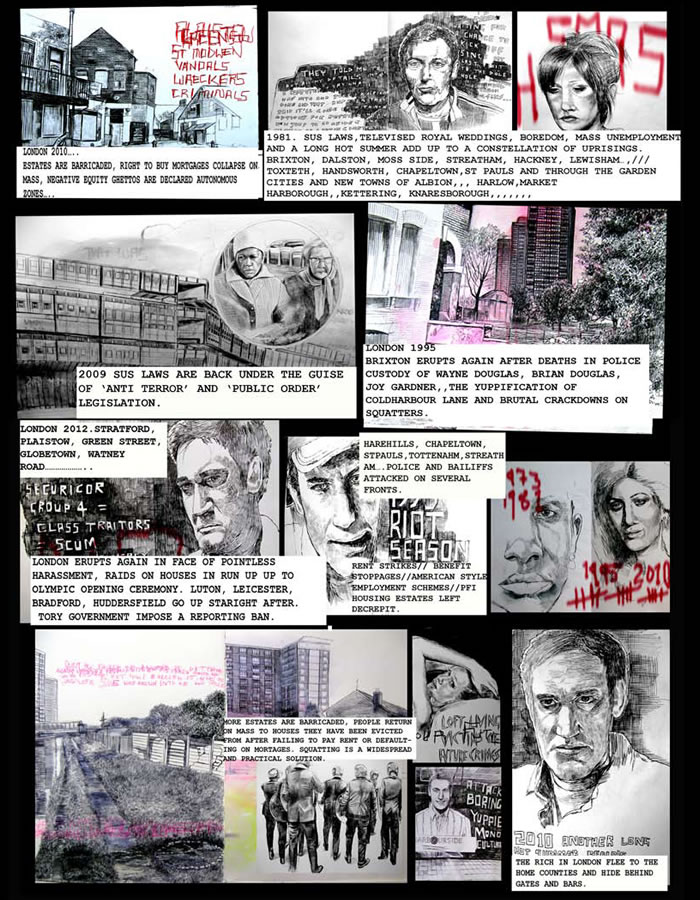
“One of the most striking fanzines of recent years is Laura Oldfield Ford’s Savage Messiah, focussing on the politics, psychology and pop- cultural past of a different London postcode. Ford’s prose is scabrous and melancholic, incorporating theoretical shards from Guy Debord and Marc Augé, and mapping the transformations to the capital that the property boom and neoliberalist economics have wrought. Each zine is a drift, a wander through landscape that echoes certain strands of contemporary psychogeography. Ford—or a version of her, at least—is an occasional character, offering up narcotic memories of a forgotten metropolis. The images, hand-drawn, photographed and messily laid out, suggest both outtakes from a Sophie Calle project and the dust jacket of an early 1980s anarcho-punk compilation record: that is, both poetry and protest.”
Friday, 21 March 2014

Futurist Manifesto

We're discussing Marx and the Communist Manifesto in class this week. In what sense was the Communist Manifesto an artwork, a literary rather than simply political, theoretical or philosophical text? In what sense has it been an influence and a model for the explosion of artistic manifestos of the twentieth century?

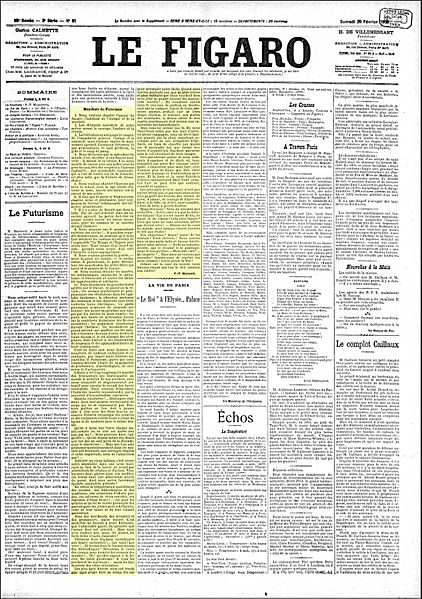
The most famous, most seminal of the avant-garde art manifestos was the Futurists' Manifesto, published in the french newspaper Le Figaro, 5 Feb 1909.

Futurist Manifesto, marked in yellow, on the front page of Le Figaro, 5 Feb 1909.
The full text of the manifesto is here:
http://vserver1.cscs.lsa.umich.edu/~crshalizi/T4PM/futurist-manifesto.html

For more artists' Manifestos, see Alex Danchev's book 100 Artists' Manifestos: From the Futurists to the Stuckists (London: Penguin, 2011).

Mary Kelly, "Post Partum Document"

Mary Kelly's Post Partum Document (1973-9) is another classic conceptualist re-articulation of the relation between text and image / theory and art – though this time from a feminist persepctive.

The work traces the development of the mother-child relationship between her and her child, starting in 1973. It provoked tabloid outrage in its initial presentation at the ICA in 1976 because of its use of soiled nappies!

The work is interesting for weaving together a series of different kinds of text (the first words and graphic marks of the child, her own personal voice as a mother, psychoanalytical/feminist theory, and the more bureaucratic discourses of the medical, etc. professions which "write" ordinary people's experience.

More can be found about the work on Kelly's website:
http://www.marykellyartist.com/post_partum_document.html


Mary Kelly, Post Partum Document, detail. Perpsex units, white card, wool vests, pencil, ink
1 of 4 units, 20 x 25.5 cm each.


Another detail. Perpsex units, white card, diaper linings, plastic sheeting, paper,ink
31 units, 28 x 35.5 cm each


Anther detail. Perpsex unit, white card, wood, paper, ink, rubber. 1 of the 26 units, 20 x 25.5 cm. Collection, Art Gallery of Ontario

Monday, 17 February 2014

Van Gogh's letters

Another monumental work of writing by an artist is Van Gogh's correspondence - especially to his brother Theo - which often provide detailed commentary not only on his life but his artistic endeavours.


They are all now available online...
http://vangoghletters.org/vg/letters/let001/letter.html


Robert Smithson


Another artist who used writing very effectively as part of their practice was the "land" artist Robert Smithson. Smithson's work already played on the complexity of the "presence" of the gallery artwork, which he defined as a "non-site" in relation to which an actual "site" which was usually situated in the landscape quite some distance from the gallery. The "artwork exists somewhere between the gallery and the outside space of the work.

Smithson's most famous work is Spiral Jetty (1970).


An example of his writing is the essay (?) "Tour of the Monuments of Passaic", which was published in Artforum in 1967. In it Smithson takes the reader on a tour of the mundane physical structures of a small-town, (post-)industrial New Jersey landscape, where the disintegrating and ramshackle industrial landmarks are re-imagined as monuments from the present-day in order to meditate on the themes of time and entropy (the "winding down of the universe") which his work is concerned with.

The essay is available here:
http://gd1studio2011.files.wordpress.com/2011/09/smithson-monuments-of-passaic.pdf

The photo-essay in Artforum was also paralleled by the exhibition of the photos themselves as "artworks", and these are currently in the collection of the Museet for Samtidkunst, Norway.

http://www.robertsmithson.com/photoworks/monument-passaic_300.htm

Michael Craig-Martin - An Oak Tree

Michael Craig Martin's An Oak Tree (1973) was another seminal piece of conceptual art that played with the relation between an artwork and a text. Here the text serves not to describe the work, but to change its effect, exploring the declarative or "performative" aspects of language.

Michael Craig-Martin, ‘An Oak Tree’ 1973

The text exhibited along with the glass of water reads:
Q. To begin with, could you describe this work?
A. Yes, of course. What I’ve done is change a glass of water into a full-grown oak tree without altering the accidents of the glass of water.
Q. The accidents?
A. Yes. The colour, feel, weight, size …
Q. Do you mean that the glass of water is a symbol of an oak tree?
A. No. It’s not a symbol. I’ve changed the physical substance of the glass of water into that of an oak tree.
Q. It looks like a glass of water.
A. Of course it does. I didn’t change its appearance. But it’s not a glass of water, it’s an oak tree.
Q. Can you prove what you’ve claimed to have done?
A. Well, yes and no. I claim to have maintained the physical form of the glass of water and, as you can see, I have. However, as one normally looks for evidence of physical change in terms of altered form, no such proof exists.
Q. Haven’t you simply called this glass of water an oak tree?
A. Absolutely not. It is not a glass of water anymore. I have changed its actual substance. It would no longer be accurate to call it a glass of water. One could call it anything one wished but that would not alter the fact that it is an oak tree.
Q. Isn’t this just a case of the emperor’s new clothes?
A. No. With the emperor’s new clothes people claimed to see something that wasn’t there because they felt they should. I would be very surprised if anyone told me they saw an oak tree.
Q. Was it difficult to effect the change?
A. No effort at all. But it took me years of work before I realised I could do it.
Q. When precisely did the glass of water become an oak tree?
A. When I put the water in the glass.
Q. Does this happen every time you fill a glass with water?
A. No, of course not. Only when I intend to change it into an oak tree.
Q. Then intention causes the change?
A. I would say it precipitates the change.
Q. You don’t know how you do it?
A. It contradicts what I feel I know about cause and effect.
Q. It seems to me that you are claiming to have worked a miracle. Isn’t that the case?
A. I’m flattered that you think so.
Q. But aren’t you the only person who can do something like this?
A. How could I know?
Q. Could you teach others to do it?
A. No, it’s not something one can teach.
Q. Do you consider that changing the glass of water into an oak tree constitutes an art work?
A. Yes.
Q. What precisely is the art work? The glass of water?
A. There is no glass of water anymore.
Q. The process of change?
A. There is no process involved in the change.
Q. The oak tree?
A. Yes. The oak tree.
Q. But the oak tree only exists in the mind.
A. No. The actual oak tree is physically present but in the form of the glass of water. As the glass of water was a particular glass of water, the oak tree is also a particular oak tree. To conceive the category ‘oak tree’ or to picture a particular oak tree is not to understand and experience what appears to be a glass of water as an oak tree. Just as it is imperceivable it also inconceivable.
Q. Did the particular oak tree exist somewhere else before it took the form of a glass of water?
A. No. This particular oak tree did not exist previously. I should also point out that it does not and will not ever have any other form than that of a glass of water.
Q. How long will it continue to be an oak tree?  
A. Until I change it 
There's more about the work here:
http://www.tate.org.uk/art/artworks/craig-martin-an-oak-tree-l02262/text-summary

Monday, 10 February 2014

Fiona Banner - film descriptions


Fiona Banner, Apocalypse Now, 1997, installation view (above) and detail (below).

Fiona Banner produced a series of works, in the late 90s, which transcribed deadpan descriptions of a series of films on giant canvases (the kind of size and shape we might expect of a movie screen itself). The long lines of (handwritten) text made the narrative difficult to follow, and engage us in a curious play of looking and reading, frustrated narrative expectation, time and immediacy. Banner's texts describing a number of Vietnam-war movies were turned into a thousand-page book, THE NAM,  and also a twenty-hour audio book. (The films she describes, back to back, would be only 11 hours!)