Thursday, 21 January 2016

Laurie Anderson

Laurie Anderson's performances involve a synthesis of elements of music, performance (she plays in complex ways with voice and persona), visual/technological spectacle, and storytelling.


In the above story, Anderson tells a story about her dog. It seems at first a simple story, but – told in the wake of 9-11 – it carries allegorical resonances of political events and American attitudes after the terrorist attacks...


Anderson made her splash in popular culture with the chart-topping song O Superman, back in the 1980s. Anderson's song was at the time technologically innovative, and strangely haunting. Its lyrically complex, with dense imagery where, again, the domestic slides into the political and the homely (even cutesy) and the uncanny collide...


Chris Marker

filmmaker Chris Marker is a master of the play between image and word. His masterpiece is probably Sunless/Sans Soleil (1983), which weaves all kinds of mystery in the gap between voiceover and image, in the juxtaposition of images, and in the play between words.

This is how the film starts:


Victor Burgin

Much work around the relation between text and image has been done by photographers – perhaps because our everyday experience of photography is so frequently mediated by the written word, and we are quite accustomed to reading between photographic images and text from existing formats of the media.

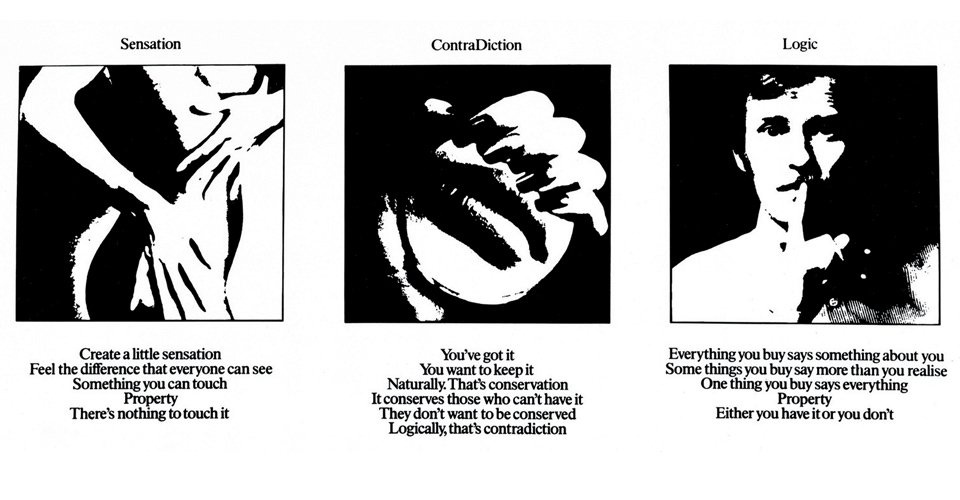
A key figure – both a photographer and a prolific writer of photographic theory – who explored the artisti plays between image and text during the 1970s was Victor Burgin.


Victor Burgin,  Possession (1976).


The poster above was flyposted around the city. It plays on (and appropriates) advertising imagery and asks about questions of 'property' in terms of gender and sex as well as social equality. Of course, today's society is actually far more unequal than the one Burgin described back in 1976. At the time of my writing (Jan 2016) this there was has been within the newspapers in the last week a study which has noted that a mere 62 of the world's richest people own more than the poorest half of the world's population. Burgin's question might come back to us again today: What does possession mean to us?

Sensation, 1975

Burgin's work of the 70s also looked at questions of gender and at the way that the fashion industry worked.

Life Demands a Little Give and Take (1974)
Burgin often played with the appropriation of different modes of writing (in the above, a kind of advertising speak), and their contrast ('montage') with disparate images.

Wednesday, 14 October 2015

Jenny Holzer

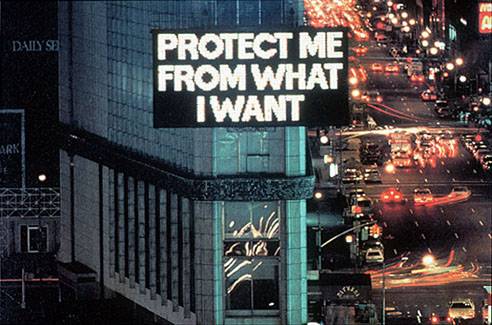
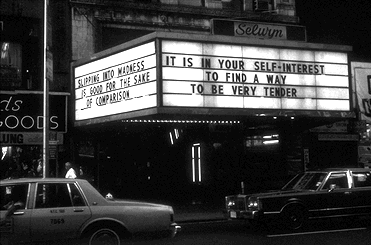
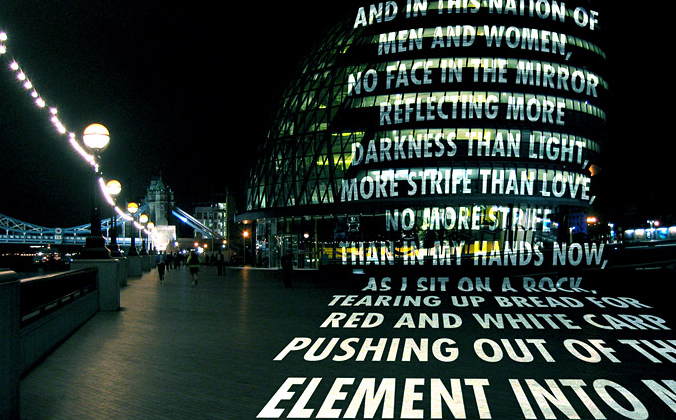
Another classic artist working with text in an art context is Jenny Holzer. In her series, the Truisms (1977-9) Holzer flyposted a series of short, enigmatic, slogan-like phrases across the urban landscape of New York, and in doing so initiated an extended exploration of he ways that text-works could be inserted into – and actively intervene within – the fabrics of the everyday world. Her exploration of this has taken the form of LED displays, advertising sites, building signage, t-shirts, polystyrene cups, and video projections. The work often interrogates the links between language, authority, space and power. and between personal and impersonal voices.

Jenny Holzer, Protect Me from What I Want, c.1982 (?), Times Square, New York.
It is in Your Self-interest to Find a Way to Be Very Tender (installed on the marquis of an abandoned movie theatre in Chicago; part of the "Truisms for Survival" Series, 1983–5.)

For London, projection, 2006.


Thursday, 12 February 2015

John Cage – Indeterminacy

Composer John Cage's Indeterminacy (1959), involved the reading aloud of a series of stories or anecdotes – some about the history of music, some with Zen ideas expressed, some about mycology (the study of mushrooms, in which Cage was an expert), some about ordinary life – all a minute long. Each is chosen at random and takes a minute to read. At the same time random musical segments were played – though in the original recording of the work, the two performers could not hear each other. If the music and text worked together (or clashed), this would be entirely serendipitous.

Here's an attempt at performing a section of the work, by Jack Goldstein, and Gloria Lin, in conjunction with the Faculty of Music at Oxford University and The Ashmolean Museum:


Here's a selection of the texts, in visual form:
http://johncage.org/indeterminacy.html

Here's comedian Stewart Lee on Cage's Indeterminacy:
http://thequietus.com/articles/09907-stewart-lee-john-cage-indeterminacy

Steve Reich – Come Out (1966) + Glenn Ligon

Steve Reich's early tape-loop work, Come Out, 1966 was a seminal piece of American avant-garde music. The work responded to the Harlem Riots of 1964, by sampling the voice of a youth involved in the riots, 19-year-old Daniel Hamm, who talked about being beaten by the police and piercing his bruise a proof of his beating, which the police denied. Reich looped a phrase from Hamm's interview – "I had to open the bruise up to let the bruised blood come out to show them" – turning it into a hypnotically rhythmical sound piece, which fluctuates between order and chaos, sense and sound, form and content, art and the political.


Black American artist Glenn Ligon recently riffed visually on the piece producing a set of large-scale paintings, with misregistered screenprints of Hamm's phrase offering a visual analogue of the sound.  (The works were shown at an exhibition at the Camden Arts Gallery at the end of last year.) 

Is Ligon's text-art a way to carry on a tradition of "history painting" after abstraction? Is the point formal play, or reference to a black history which seemed to be being repeated in the Ferguson Riots around the time this work was being shown? (Another form of repetition?) Or is the point the "poetic" gulf between the work's formal play and its historical referent?


Glenn Ligon, from the Come Out series, 2014.


Further links:
Camden Arts Centre:

Thomas Dane Gallery – Ligon's London representative:

Luhring Augustine – Ligon's New York gallery.


Freee

The artists' collective, Freee, have an interesting practice developing playful forms of political text.

Here's a recent piece – a section from the "Manifesto for Counter-Hegemonic Art", which appropriates and "hacks" Marx's famous Communist Manifesto.

http://www.hewittandjordan.com/freee/manifesto/freee_manifesto_p1.pdf

More on the manifesto here:
http://freee.org.uk/2007/01/12/the-freee-art-collective-manifesto-for-a-counter-hegemonic-art/

Here are a couple of further images of their practice:-

Free Collective, Advertising Wants To Convert Our Desire For A Better Life Into A Desire To Buy Something, billboard, 2008.

Freee Collective, The Economic Function of Public Art is to Increase the Value of Private Property, 2004.